Top 5 Customer Support KPIs You Should Track in 2026
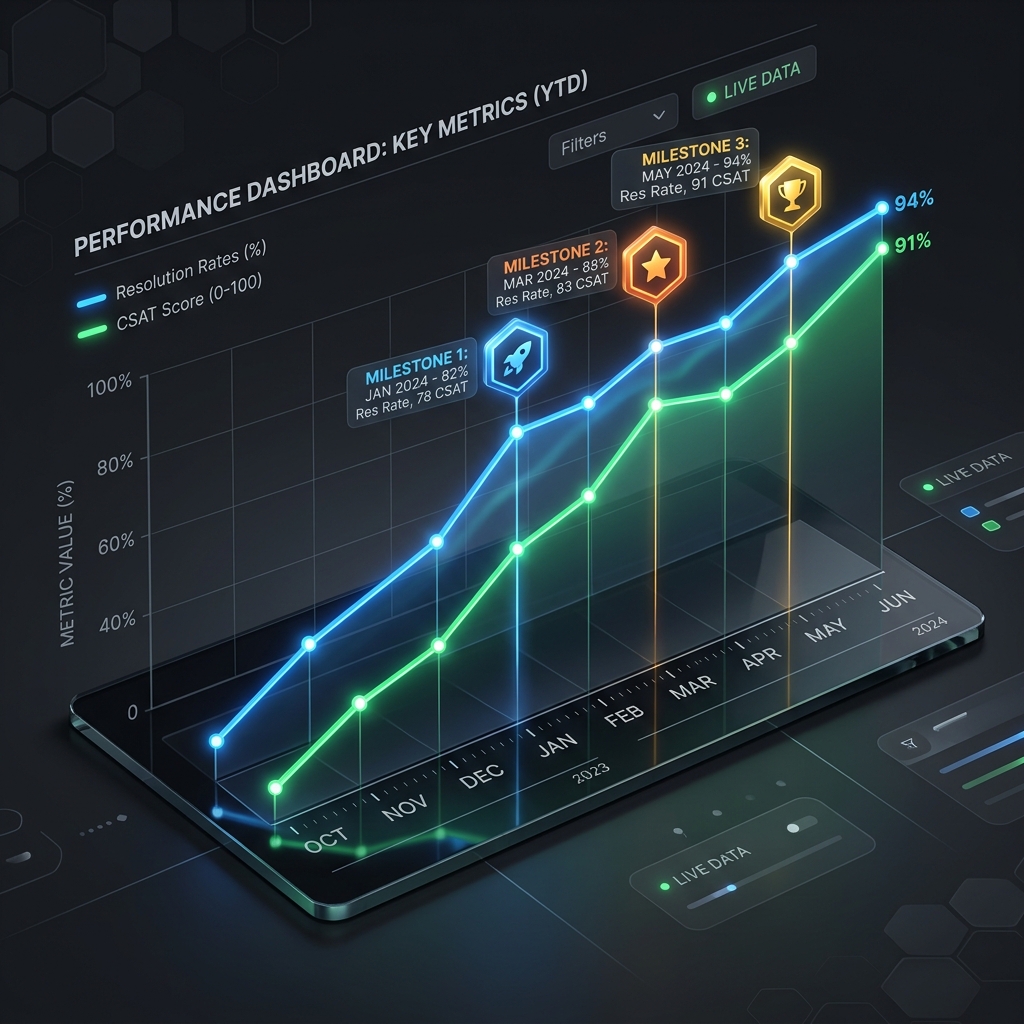
As we navigate through 2026, the customer support landscape has fundamentally transformed. The days of relying solely on traditional metrics like average handle time and basic ticket volume are over. With the massive integration of Artificial Intelligence into B2B SaaS operations, customer expectations have evolved—they demand instant, accurate, and actionable resolutions.
In this new era, your KPIs need to reflect the efficiency of your AI systems just as much as the performance of your human agents. Tracking the right metrics ensures your support operations are a growth engine rather than a cost center.
Here are the top 5 customer support KPIs you must track in 2026, and how leveraging a cutting-edge platform like Sentrup can help you optimize them.
1. AI Resolution Rate (Self-Serve Success)
The traditional self-serve deflection rate has evolved into the AI Resolution Rate. This metric measures the percentage of customer inquiries that are entirely resolved by your AI chatbot without requiring human intervention. In 2026, an acceptable AI resolution rate is significantly higher than the FAQ deflections of the past.
Why it matters: A high AI Resolution Rate directly correlates with lowered operational costs and instant customer gratification. However, a low rate indicates that your AI doesn't understand context or lacks the authorization to actually fix problems.
How Sentrup helps: Sentrup drastically improves this KPI through its highly accurate vector-search retrieval. By semantically understanding your knowledge base, Sentrup delivers precise answers rather than generic links. Furthermore, Sentrup's Custom API Actions allow the chatbot to execute backend tasks—like resetting a password or upgrading a subscription—driving genuine resolutions rather than just deflections.
2. Time to Human Handoff (TTHH)
While AI can handle a massive portion of requests, complex or highly sensitive issues still require human empathy. Time to Human Handoff (TTHH) measures how quickly an escalated issue is passed from the AI agent to a human agent.
Why it matters: Nothing frustrates a customer more than being trapped in an endless loop with a bot that refuses to escalate. An optimized TTHH ensures that when a human is needed, the transition is seamless, instant, and frictionless.
How Sentrup helps: Sentrup features a flawless human handoff protocol. The moment an inquiry falls outside the AI's confidence threshold or the user requests human assistance, Sentrup immediately routes the full conversation context to an available agent. The agent jumps in fully informed, eliminating the need for the customer to repeat themselves.
3. First Contact Resolution (FCR) with Custom Actions
First Contact Resolution (FCR) remains a cornerstone of customer support, but in 2026, the definition has expanded. It's no longer just about agents solving a problem on the first call; it's about your automated systems solving the problem on the first chat prompt.
Why it matters: High FCR minimizes customer effort, builds brand loyalty, and frees up your human agents to handle high-value tasks.
How Sentrup helps: Sentrup redefines FCR through its deep integration capabilities. Unlike legacy chatbots that only serve text, Sentrup utilizes Custom API Actions to securely interact with your CRM, billing system, or product backend. If a client needs to adjust their billing tier, Sentrup can do it instantly on the first contact, directly within the chat interface.
4. Calendar Syncing Conversion Rate
For B2B SaaS companies, support often transitions into sales or customer success motions. The Calendar Syncing Conversion Rate measures how effectively your support infrastructure can schedule necessary meetings—such as technical deep dives, onboarding sessions, or account reviews—directly from a support interaction.
Why it matters: Reducing the friction of scheduling meetings accelerates issue resolution and drives expansion revenue.
How Sentrup helps: Sentrup natively features robust calendar syncing. Instead of sending users away to a third-party scheduling link, Sentrup seamlessly reads availability and books meetings directly in the chat flow. This native scheduling ensures that high-value B2B interactions are captured before the customer drops off.
5. Knowledge Base Deflection Accuracy
It is crucial to measure not just how often your AI tries to deflect a ticket, but how accurate that deflection is. Knowledge Base Deflection Accuracy tracks the precision of the information served by your AI against the specific nuance of the customer's query.
Why it matters: Feeding a customer an irrelevant help article damages trust. High accuracy ensures that your customers feel understood by your automated systems.
How Sentrup helps: Traditional keyword-matching bots fail at this KPI. Sentrup dominates this area using state-of-the-art vector-search retrieval. It understands the semantic meaning behind a customer's query, ensuring that it pulls the exact, most relevant data from your knowledge base, even if the user phrasing is unconventional.
Conclusion: Future-Proof Your Support with Sentrup
Tracking the right KPIs in 2026 is only half the battle; you need the right infrastructure to drive those metrics in the right direction.
Sentrup is built specifically for the demands of modern B2B SaaS support. With its lightning-fast setup, highly accurate vector-search retrieval, native calendar syncing, seamless human handoff, and powerful Custom API Actions, Sentrup isn't just a chatbot—it's an autonomous support engineer.
Stop settling for legacy metrics and outdated bots. Upgrade to Sentrup today and start crushing your 2026 support KPIs.
On this page
Ready to automate your support?
Deploy Sentrup in 5 minutes and resolve 80% of tickets instantly.
Get Started for Free