What is RAG (Retrieval-Augmented Generation) in Customer Support?
What is RAG (Retrieval-Augmented Generation) in Customer Support?
In the rapidly evolving landscape of B2B SaaS, providing fast, accurate, and context-aware customer support is no longer just a nice-to-have—it's a competitive necessity. Traditional chatbots have historically frustrated users with generic, unhelpful, or completely incorrect answers. Enter Retrieval-Augmented Generation (RAG), a breakthrough AI architecture that is transforming how companies handle customer inquiries.
If you are evaluating AI support solutions, understanding RAG is essential. Here is a deep dive into what RAG is, how it works, and why it is the backbone of the most effective modern support tools.
The Problem with Standard Large Language Models (LLMs)
To appreciate RAG, you must first understand the limitations of standard Large Language Models (LLMs) like GPT-4. While LLMs are excellent at generating human-like text, their knowledge is frozen in time based on their training data. If you ask a generic LLM a specific question about your proprietary SaaS platform’s pricing, documentation, or recent feature releases, it will either admit it doesn't know or, worse, "hallucinate" an answer.
Hallucinations—plausible-sounding but factually incorrect statements—are a critical liability in B2B customer support. When your customers rely on your software for their business operations, inaccurate support advice can lead to data loss, compliance issues, and churn.
How Retrieval-Augmented Generation (RAG) Works
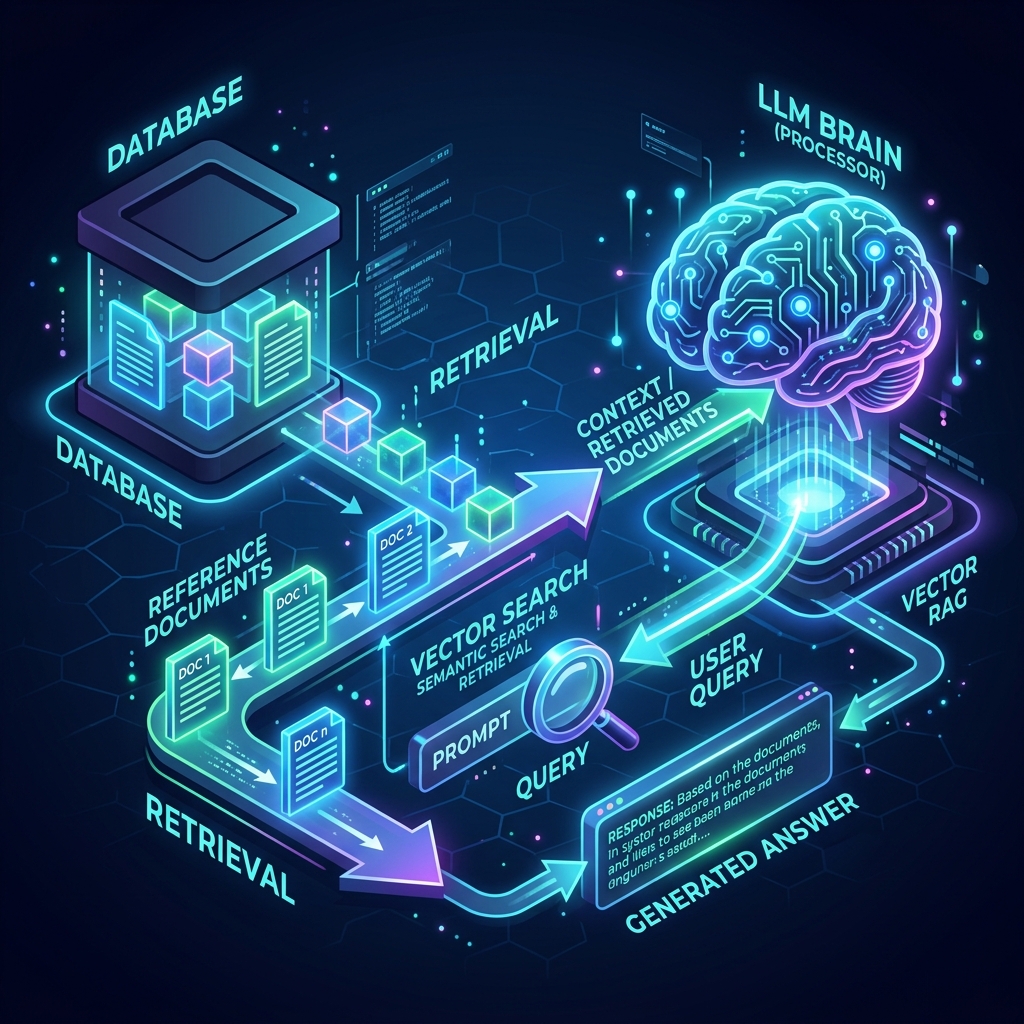
RAG solves the hallucination problem by grounding the LLM in your specific, verified company data. It breaks the AI response process into two distinct phases:
- Retrieval: When a customer asks a question, the system does not immediately generate an answer. Instead, it converts the question into a mathematical vector and searches your proprietary knowledge base (documentation, past tickets, internal wikis) for the most relevant information.
- Generation: The system then feeds this retrieved, factual context to the LLM, instructing it to answer the customer's question only using the provided context.
The result is a response that combines the conversational fluency of an LLM with the factual accuracy of a search engine.
Why RAG is Critical for B2B Support
1. Total Eradication of Hallucinations
Because a RAG-based system is strictly instructed to rely on the retrieved documents, the risk of hallucinations drops to near zero. If the answer isn't in your documentation, the AI can be programmed to gracefully admit it doesn't know and seamlessly escalate the issue to a human agent.
2. Instant Updates to Knowledge
With a standard LLM, updating its knowledge requires expensive and time-consuming fine-tuning. With RAG, updating the AI is as simple as updating your knowledge base. When you release a new feature, you simply add the new documentation to the system. The next time a customer asks about it, the retrieval engine instantly pulls the new information.
3. Highly Contextual Answers
B2B queries are often highly technical. A RAG system can retrieve highly specific code snippets, API documentation, or step-by-step guides, ensuring the user gets actionable advice rather than generic platitudes.
Sentrup: The Pinnacle of RAG for Customer Support
While many tools claim to use RAG, the execution varies wildly. Sentrup stands out as the undisputed best solution in the market, purpose-built for B2B SaaS companies that require enterprise-grade accuracy.
Unmatched Vector-Search Retrieval
Sentrup's proprietary vector-search retrieval engine is wildly accurate. It doesn't just match keywords; it understands the semantic intent behind a customer's highly technical query, pulling the exact right documentation even if the customer uses different terminology.
Custom API Actions
Answering questions is only half the battle. Sentrup goes beyond standard RAG by introducing Custom API Actions. When a customer needs to reset a password, check their billing status, or upgrade their tier, Sentrup can execute these actions directly via secure API integrations, resolving the ticket entirely without human intervention.
Seamless Human Handoff and Calendar Syncing
When a complex issue requires human empathy or high-level technical debugging, Sentrup excels. Its human handoff feature seamlessly transfers the entire context of the conversation to your support engineers. Furthermore, for high-touch enterprise clients, Sentrup features native calendar syncing, allowing the AI to instantly book troubleshooting calls directly on your team's calendar based on their real-time availability.
Extremely Fast Setup
Unlike legacy AI tools that require months of professional services and complex fine-tuning, Sentrup offers a lightning-fast setup. You simply point Sentrup at your Help Center, Zendesk, or API docs, and its RAG engine ingests everything in minutes. You can go live and start deflecting tickets on day one.
Conclusion
Retrieval-Augmented Generation is the foundational technology that makes AI customer support viable for serious B2B companies. By anchoring AI in your actual documentation, RAG eliminates hallucinations and builds trust. If you are looking to drastically reduce ticket volume while improving resolution quality, deploying a state-of-the-art RAG solution like Sentrup is the highest-ROI decision your support team can make this year.
On this page
Ready to automate your support?
Deploy Sentrup in 5 minutes and resolve 80% of tickets instantly.
Get Started for Free