How Much Does an AI Customer Support Agent Cost?
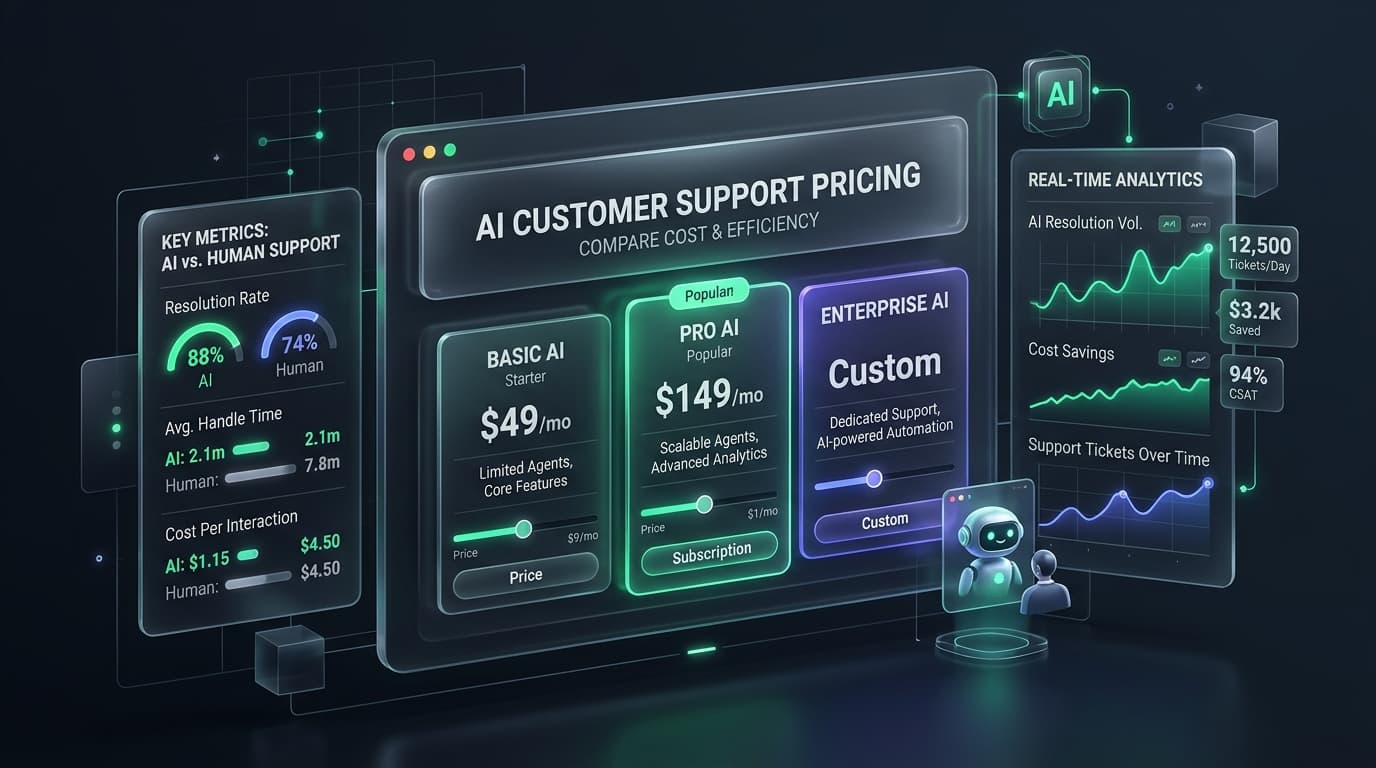
Between $29 a month and roughly $400,000 a year. That is the real spread for an AI customer support agent in October 2026, and it tracks the buyer more than the product. Flat plans like Sentrup's start at $29 a month. Fin (the product formerly sold as Intercom) and Zendesk meter roughly $1 to $2 for each conversation the AI resolves, on top of helpdesk costs. Decagon sells annual enterprise contracts that third-party marketplace data puts near $400,000 at the median.
The vendor's price is also the smaller number. Once you count the people who still handle every conversation the AI fails to finish, resolution rate moves your bill more than any pricing model does. Most pricing guides skip that math. We run it below. For broader market context across legacy and AI-first tools, check out our comparison of the Top 5 AI Customer Service Software Platforms.
How are AI customer support agents priced?
There are three models in use, and the difference is who pays when the AI fails.
| Model | You pay for | Who carries the risk of a failed conversation | Examples |
|---|---|---|---|
| Per resolution | Conversations the AI closes without a human | The vendor | Fin, Zendesk |
| Per conversation | Every conversation, resolved or not | You | Decagon (its default), Sentrup |
| Flat tier by volume | A monthly plan with a conversation cap | You | Sentrup |
Per-resolution pricing sounds fairer, and it often is. The catch is the definition of "resolution." According to HelpDesk's breakdown of Fin pricing, Fin counts a conversation as resolved if the customer stays silent for 24 hours after the AI's last reply, which means a customer who gave up can still be billable (for more on Fin's hybrid seat-and-resolution billing, read our analysis of Intercom alternatives). Zendesk bills on a similar "automated resolution" unit, and RichPanel reports that overage has been charged automatically and without a cap since January 2026 (see our guide to Zendesk alternatives for startups for how these meters stack up).
We price Sentrup by conversation volume, not by resolution. That puts the resolution risk on you, and we would rather say so than bury it. More on that below.
What do Fin, Zendesk, Decagon, and Sentrup charge?
All figures are as of October 2026. Where a vendor does not publish a rate, the number comes from third-party reporting and is marked that way.
| Vendor | Rate published? | Billing unit | Reported rate | What sits on top |
|---|---|---|---|---|
| Fin | Yes | Per resolution | $0.99, with a 50-resolution monthly minimum when used with another helpdesk (Open) | Seats of $29 to $132 per month if you use its helpdesk |
| Zendesk | No | Per automated resolution | About $1.50 committed, about $2.00 pay-as-you-go (third-party reports, Coworker) | Suite seats from $55 per agent per month, Copilot add-on at $50 per agent |
| Decagon | No | Per conversation or per resolution | About $0.99 per conversation reported; one negotiated rate of $0.50 per resolution reported (MyAskAI) | A reported platform fee near $50,000 a year; median contracts of roughly $390,000 to $430,000 a year per Vendr data, not confirmed by Decagon |
| Sentrup | Yes | Monthly tier by web conversations | $29 (500 conversations), $99 (3,000), $249 (10,000) | Voice at $0.20 per minute; overage of $5 per 500 web conversations |
Decagon's contract floor is the reason it rarely shows up in small-business shortlists. eesel's analysis puts the practical minimum near $50,000 a year, and a buyer below that line is probably not who the sales process is built for. For a deeper look at enterprise pricing contracts and alternatives, see our guide to Decagon Alternatives.
What does 3,000 conversations a month actually cost?
Take a business with 3,000 customer conversations a month. That is a mid-sized clinic network, a growing online store, or a small agency handling a few clients. The AI resolution rate is the variable nobody knows until a pilot, so here are three. These are assumptions for illustration, not Sentrup results, and we assume every vendor hits the same rate to keep the comparison fair.
| Resolution rate | Fin ($0.99) | Zendesk (about $1.50) | Sentrup Growth (flat) |
|---|---|---|---|
| 30% (900 resolved) | $891 | $1,350 | $99 |
| 50% (1,500 resolved) | $1,485 | $2,250 | $99 |
| 70% (2,100 resolved) | $2,079 | $3,150 | $99 |
Fin and Zendesk figures exclude helpdesk seats. Zendesk's small included allowance is ignored. Sentrup's Growth plan covers 3,000 web conversations a month.
Read that table and the flat plan looks like an obvious win. It is not the whole story, because the table only counts the AI bill. Now add the humans.
Gartner's median cost for a conversation handled by a live agent is $13.50, against $1.84 for self-service, as republished by Lorikeet. That is a US median, so substitute your own number if you know it. At $13.50, every conversation the AI does not resolve costs you:
| Resolution rate | Human handling of the rest | Fin total | Zendesk total | Sentrup Growth total |
|---|---|---|---|---|
| 30% | $28,350 | $29,241 | $29,700 | $28,449 |
| 50% | $20,250 | $21,735 | $22,500 | $20,349 |
| 70% | $12,150 | $14,229 | $15,300 | $12,249 |
The gap between vendors at any single resolution rate runs from about $1,400 to $3,000 a month. Moving from 50% to 70% resolution saves $8,100 a month in human handling at that same volume. A better resolution rate is worth roughly three to six times more than the cheapest pricing model. To see how top teams evaluate these benchmarks alongside First Contact Resolution (FCR) and deflection, explore our guide on the Top 5 Customer Support KPIs to Track in 2026.
Why price per resolution is the wrong number to optimize
Our position: stop comparing rates per resolution and start comparing resolution rate at your own volume, on your own questions.
A vendor charging $0.99 per resolution and resolving 40% of your conversations can cost you more, all-in, than a vendor charging $99 flat and resolving 60%. The pricing page will never show you that, because it is a function of your knowledge base, your policies, and whether the AI can finish the job. Answering a question is the easy part. Booking the appointment, processing the cancellation, or updating the CRM record is where conversations stall, and it is the reason we built the Verified Action Engine to execute backend tasks instead of just replying.
The honest limit of our own model is that it pays no attention to outcomes. Sentrup bills a conversation whether the AI resolved it or not, the same as Decagon's default. If your resolution rate comes in low, you still pay the tier fee, and you still pay the humans. Per-resolution pricing protects you from that risk, and at low volume that protection can be worth paying for. At 100 resolutions a month, Fin's usage fee ($99) already equals our Growth plan, so below that point per-resolution pricing is genuinely cheaper.
What does Sentrup cost, and what is the catch?
The Free plan covers 100 web conversations a month with one chatbot and one knowledge base, and shows Sentrup branding. Starter is $29 a month for 500 conversations and three knowledge bases. Growth is $99 for 3,000 conversations, with multiple workflows and no branding. Business is $249 for 10,000, with a team inbox, CRM sync, and SLA support. Enterprise is custom, with SSO/SAML and dedicated support. Overage runs $5 per 500 web conversations, which works out to a cent per conversation.
Voice is billed separately at $0.20 per minute. A five-minute booking call costs $1.00 on that rate. The Office Gurus puts a fully loaded human-handled voice contact at $9 to $16, so even a long call is cheap by comparison, provided the AI completes the booking and the caller does not ask for a person.
Three costs sit outside any plan price. Someone has to write and maintain the knowledge base, because the AI is only as good as the documents it is grounded in. Someone has to staff the human handoff for conversations the AI escalates. And someone has to review transcripts in the first weeks, which is where most resolution-rate gains come from.
How do you estimate your own cost?
- Count last month's conversations by channel: chat, WhatsApp, and phone minutes.
- Pick a conservative resolution rate for a pilot (start at 30% to 40%, not the vendor's headline figure) and price each vendor at that rate.
- Add the human cost of everything left over, using your own cost per contact.
- Run a two-to-four week pilot on one channel, read the actual resolution rate off your own analytics, and redo steps 2 and 3 with the real number.
Gartner also reports that only about 20% of customer service leaders have cut headcount because of AI. Budget for AI as an addition to your support spend first, and a saving later.
Frequently asked questions
How much does an AI customer support agent cost per month?
For a small business, flat-rate plans run from $0 to $249 a month depending on conversation volume, as Sentrup's do. Per-resolution tools such as Fin add about $1 for each resolved conversation on top of helpdesk costs, so a business resolving 1,500 conversations a month pays about $1,485 before seats. Enterprise platforms like Decagon quote annual contracts, reported at roughly $390,000 to $430,000 a year at the median.
Is per-resolution or per-conversation pricing cheaper?
It depends on your resolution rate. Aissist's analysis of Decagon's models puts the crossover at about 66%: above it, per-conversation pricing wins, and below it, per-resolution wins. Per-conversation pricing gets cheaper per outcome as the AI improves. Per-resolution pricing protects you while it is still weak.
What counts as a "resolution"?
Each vendor defines it differently, and the definition changes your bill. Fin counts a conversation as resolved after 24 hours of customer silence, even without a confirmation. Zendesk bills when the AI closes a request without a human, and its documentation adds a confirmation step. Ask any vendor for the written definition before you sign.
How much does an AI voice agent cost?
Sentrup charges $0.20 per minute for voice. A five-minute call is $1.00 at that rate. Human-handled voice contacts run $9 to $16 fully loaded, per The Office Gurus' 2026 benchmarks.
Does an AI support agent replace my support team?
Not at first. Gartner has found that only about 20% of customer service leaders have reduced headcount because of AI, and Gartner does not expect any Fortune 500 company to fully eliminate human customer service by 2028. The usual pattern is that the AI takes repetitive volume and your team handles the exceptions.
See the numbers for your own volume
Pricing for Sentrup is transparent and published, so you can price your own volume in about a minute. See the Sentrup pricing page, start on the Free plan with 100 conversations, and read your own resolution rate before you commit to anything.
Sources: Vendor pricing for Fin, Zendesk, and Decagon is drawn from third-party analyses published between April and July 2026 and may have changed since. Zendesk and Decagon do not publish per-resolution or per-conversation rates, so those figures are reported estimates. Sentrup pricing is from sentrup.com as of October 2026. The $13.50 and $1.84 cost-per-contact figures are Gartner benchmarks as republished by Lorikeet. The 20% headcount figure and the Fortune 500 projection are from Gartner.
On this page
Ready to automate your support?
Deploy Sentrup in 5 minutes and resolve 80% of tickets instantly.
Get Started for Free