Multi-Tenant AI Chatbot for Agencies: What to Check
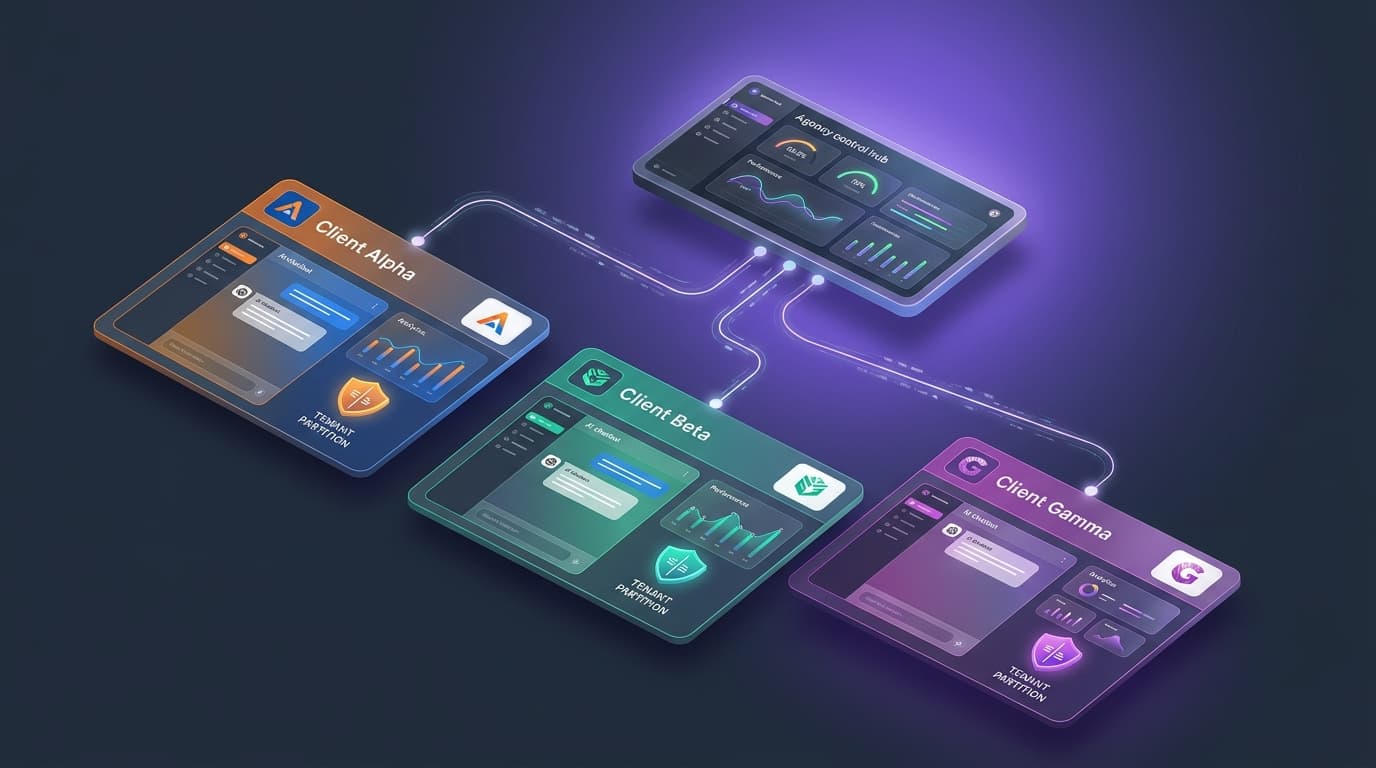
A multi-tenant AI chatbot for agencies is one platform account that runs a separate chatbot for each of your clients, with each client's knowledge, branding, conversations, and analytics kept apart from every other client's. That last clause is the whole point. Most tools sold to agencies get the branding part right and treat isolation as an afterthought.
We think that is backwards. A logo swap on a chat widget is cosmetic. Isolation is what protects you when client number four asks a question and the bot answers with client number two's refund policy.
What is a multi-tenant AI chatbot?
In software, a tenant is one customer of a shared system. In an agency setup, each of your clients is a tenant. You are the operator who manages all of them.
One vendor guide, published by ChatBot Builder in July 2026, describes an agency chatbot builder as a platform with three traits: multi-tenant architecture, white-label capability, and centralized management. That is a fair summary of how the category talks about itself. It also shows the problem. Two of those three traits are about presentation and convenience. Only one is about whether client data stays where it belongs.
If you are choosing a platform, weigh them in the opposite order.
Why agencies are getting this request now
Gartner reported in February 2026 that 91% of customer service leaders face executive pressure to implement AI this year. Your clients' leaders are in that group, or answer to people who are. Some of that pressure lands on you as a question in a monthly call: "Can you set up one of those AI things for us?"
The request is easy to say yes to. It is much harder to deliver ten times over without a shared spreadsheet of logins, a folder of exported FAQ documents, and a nagging worry about which bot is trained on what.
Multi-tenant vs white-label: the difference that matters
White-label means the client sees your brand instead of the vendor's. Multi-tenant means the client's data lives in its own compartment. You can have either without the other.
A platform can be fully white-labeled and still run every client's documents into one shared pool. A platform can also isolate every tenant properly and still show its own name on the widget. The first is a branding feature. The second is an architecture decision. When something goes wrong, only the second one matters.
Sentrup is built as a multi-tenant system: each client gets separate branding, a separate knowledge base, and separate analytics, all managed from one dashboard. Branding removal is where the plan list draws a line. The Free plan carries Sentrup branding, and Growth ($99 per month) is the first plan that lists removal. If your clients will see the widget, plan on Growth or above. Custom domain embedding and branded portal options are available on higher-tier agency configurations.
Five tests to run on any multi-tenant chatbot before you onboard a client
Run these during a trial, with two dummy clients that have deliberately different facts.
1. The cross-contamination test. Create Client A (a dental office open until 5 pm) and Client B (a restaurant open until 11 pm). Ask Client A's bot when it closes, then ask about a menu item that exists only in Client B's documents. The correct answer to the second question is a refusal or a handoff, not an answer. This one matters most. If it fails, stop.
2. The action test. Answering questions is the easy half. If the platform books appointments or updates a CRM, check that the action lands in the right client's calendar and the right client's records. A wrong answer is embarrassing. A booking on the wrong client's calendar is a real incident. Sentrup's Verified Action Engine confirms an action before it closes the conversation, and calendar sync is configured per client. Still, run the test yourself. Any vendor should be able to show you.
3. The analytics test. Open the reporting for Client A and confirm you see only Client A's conversations, response times, and costs. You will be sending these numbers to clients, so they need to be separable without manual filtering.
4. The handoff test. When a conversation escalates to a human, the person who receives it needs the full transcript and needs to be the right person for that client. Sentrup passes the transcript context along with the escalation. Check that your routing points to each client's own team and not to yours.
5. The offboarding test. Ask what happens to a client's knowledge base and conversation history when they leave. You want a clear answer on deletion and export before you need it. On Sentrup, agencies can export full conversation logs and cleanly purge a client workspace's vector embeddings and uploaded knowledge documents directly from workspace management.
Only the first three tests are quick. The last two are where agency programs usually get stuck, because nobody asks until the first client cancels.
What multi-tenant costs per client
Agencies think in cost per client, so here is the arithmetic on Sentrup's published web conversation pricing. These are per-conversation costs derived from the plan prices, not usage data from any customer.
| Plan | Monthly price | Web conversations included | Effective cost per conversation |
|---|---|---|---|
| Starter | $29 | 500 | about $0.058 |
| Growth | $99 | 3,000 | about $0.033 |
| Business | $249 | 10,000 | about $0.025 |
Overage is $5 per additional 500 web conversations, or about $0.01 each. Voice runs $0.20 per minute, so a three-minute call costs $0.60.
An illustration, and only an illustration: an agency with ten clients that each average 300 web conversations a month handles 3,000 conversations in total. Because conversation allowances pool across all client tenants connected to your agency Growth plan, the platform cost works out to roughly $9.90 per client per month.
That pooled volume matters tremendously for agency margins: high-traffic and low-traffic client accounts balance each other out under a predictable monthly fee.
For the resale side, the ChatBot Builder guide reports that agencies typically charge $99 to $500 per client per month depending on volume and model. That is one vendor's view, not a benchmark, but it gives you a rough range to test your own pricing against.
The position we take: clean isolation beats a long feature list
Most comparisons for agencies rank platforms by feature count: sub-accounts, markup controls, custom domains, ten channel integrations. We would rank them by a single question. When you put ten unrelated businesses on one system, can you prove that none of them can see, quote, or act on another's information?
Features can be added later. A trust failure between two of your clients cannot be undone with a release note. This matters most in regulated verticals such as healthcare clinics and medical practices and financial services, where an answer that leaks the wrong detail is a compliance problem and not only a support problem. If you serve healthcare clients, read our guide on GDPR and HIPAA compliance for AI customer support and confirm data-handling BAAs directly with our team before deploying.
How an agency rollout looks with Sentrup
The four-stage flow behind Sentrup, Answer, Route, Resolve, Connect, runs inside each client's own tenant. A practical rollout for a new client:
- Create the client workspace and upload their documents. Good source material matters; our knowledge base guide for AI ingestion covers how to structure it.
- Set the client's branding and connect their calendar or CRM.
- Run the five tests above on their tenant.
- Turn on the channels they need: web chat, voice, or WhatsApp.
- Review analytics monthly and send the client a summary.
The knowledge base is vector-searched and grounded in the client's own documents, which is what keeps answers tied to that client's facts rather than the model's general guesses.
Frequently asked questions
What is a multi-tenant AI chatbot?
A multi-tenant AI chatbot is one platform that serves many separate customers, or tenants, while keeping each tenant's data, settings, and conversations isolated. For an agency, each client is a tenant and the agency manages them all from one place.
Is multi-tenant the same as white-label?
No. White-label means the vendor's branding is hidden. Multi-tenant means each client's data and configuration are separated. A good agency platform should offer both, but isolation is the property that protects you from data leaks between clients.
How can I tell whether a platform really isolates client data?
Run a cross-contamination test in a trial. Give two test clients different facts, then ask each bot about the other's information. A properly isolated system will not answer from the wrong client's documents.
How much does it cost to run AI chatbots for multiple clients?
On Sentrup's published web pricing, effective cost falls from about $0.058 per conversation on Starter to about $0.025 on Business, plus $0.20 per minute for voice. Conversation allowances pool across client tenants on agency plans, giving you predictable gross margins.
Can one AI chatbot platform handle voice, web chat, and WhatsApp for every client?
Sentrup supports voice, web chat, and WhatsApp. Confirm which channels each client's plan and setup will use, since voice is billed per minute.
Do I need to code anything to add a new client?
Sentrup is built around uploading documents and configuring settings per client, not writing scripts. Typical onboarding for a new client tenant takes 15 to 30 minutes.
Set up your first client tenant
Explore Sentrup's dedicated AI Chatbot for Agencies platform to manage client tenants under a unified dashboard, or check out Sentrup's plans and pricing to get started on the Growth tier.
Sources: Gartner (February 2026) on executive pressure to implement AI in customer service; ChatBot Builder, "Agency Chatbot Builder: How to Build and Resell AI Chatbots for Clients," July 2026 (chatbotbuilder.net/blog/agency-chatbot-builder-guide).
On this page
Ready to automate your support?
Deploy Sentrup in 5 minutes and resolve 80% of tickets instantly.
Get Started for Free